
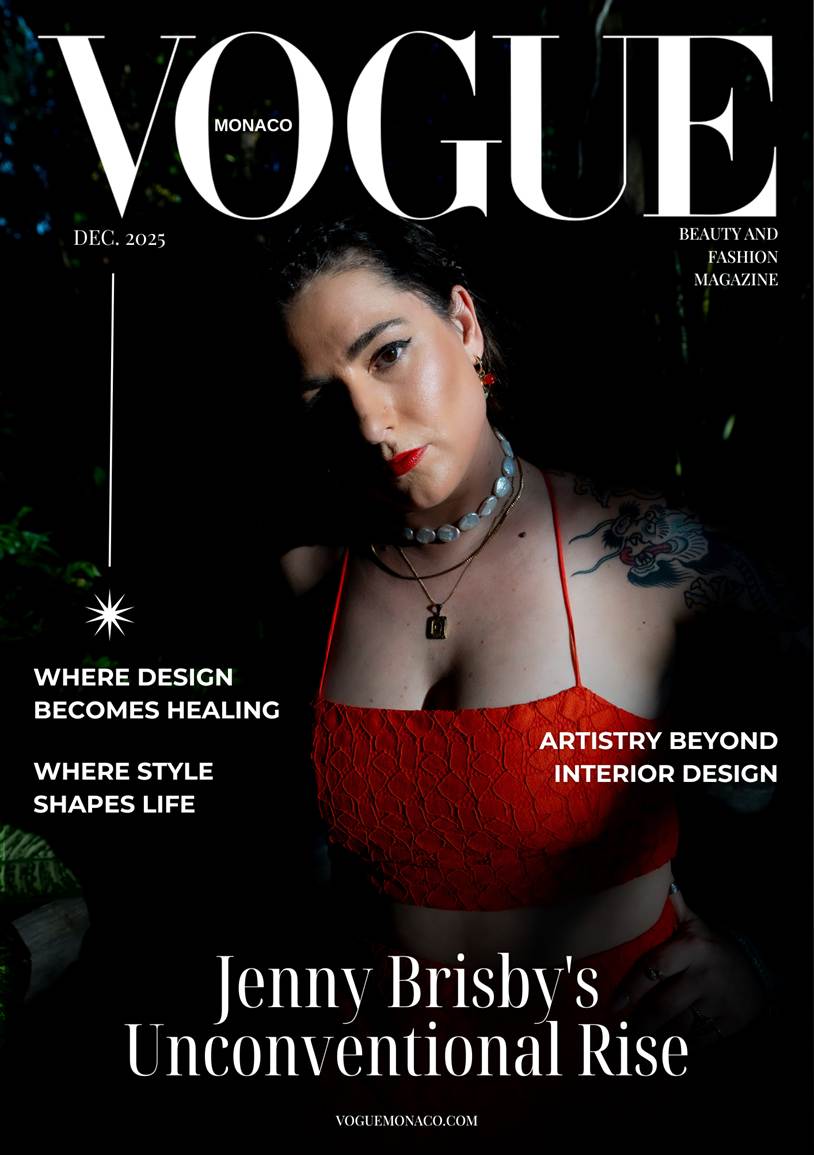
From answering phones at a snowboard company to landing magazine covers, one creative’s journey challenges traditional notions of what it means to build spaces—and careers
Jennifer Brisby doesn’t fit neatly into the interior design establishment. She apprenticed at a prestigious New York firm, earned her master’s degree, and has worked across three continents. But ask her what she does for a living, and she’ll correct you: “I’m not a designer. I’m an artist and a healer.”
It’s an unconventional self-description in an industry known for pragmatism and client service. Yet this approach has taken Brisby from launching a studio while still in graduate school to securing features in Forbes, Vogue, and Glamour, with projects now spanning from Costa Rica to the Middle East.
An Unlikely Start

Brisby’s entry into design came through an unexpected route. Her first job was answering phones—in English and French—at Burton Snowboards. What began as administrative work evolved into roles across brand marketing, product development, and manufacturing for both hardgoods and soft goods.
“Those years shaped how I see things,” Brisby said, describing how the experience taught her to balance aesthetics with function, storytelling with craft.
The pivot to interior design came when she moved to Brooklyn to pursue a master’s degree at the New York School of Interior Design. While studying, she apprenticed for MR Architecture & Decor, a firm known for merging architectural precision with artistic expression.
In a move that surprised even her mentors, Brisby launched her own studio before graduation—a gamble that marked the beginning of an unconventional career path.
Going Global

After establishing herself across several U.S. cities—Los Angeles, Boston, and Vermont—Brisby made a decision in 2016 that would redefine her practice: she moved internationally.
“I wanted to expand globally,” she explained. “New landscapes became new influences. New cultures, new textures, new creative frontiers.”
The move transformed her studio from a regional practice into what she describes as “an extension of my identity”—one that operates across borders and refuses conventional categorization.
Where Fashion Meets Space

Brisby’s work occupies a distinctive niche: the intersection of fashion, lifestyle, and environmental design. She approaches interiors the way fashion houses approach collections, treating homes and offices as expressions of personal style rather than simply functional spaces.
“I see design as emotional, not just visual,” she said. “It’s about how a space feels, how it moves, how it heals.”
This philosophy extends to her client relationships. When asked about her selection process, Brisby’s answer is blunt: “They come to me. I only work with clients who resonate.”
It’s a selective approach that prioritizes what she calls “energetic compatibility” over conventional business development—a luxury afforded to designers whose reputation precedes them.
A Different Definition of Success
For Brisby, career milestones aren’t measured in revenue or square footage. “Success is doing what you love,” she said, articulating an ethos that explains her willingness to cross disciplines and continents with apparent ease.
Still, traditional markers of achievement have followed. One of her proudest moments came when her work appeared on the cover of ELLE—a validation that intuition and authenticity could coexist with commercial recognition.
Her client base reflects her stated muse: “iconic personal style and powerful women.” Brisby designs not just for women, she says, but for their identities to inhabit fully.
What’s Next
Brisby’s upcoming projects signal an increasingly ambitious scope. In addition to editorial features in major publications, she’s working on a Sotheby’s office design, developing two large fincas in Costa Rica, and importing design elements from the Middle East.
Each project reflects what she describes as a “global vision”—one that balances luxury with groundedness, avant-garde sensibility with accessibility.
The Healer’s Touch
From her early days at Burton to her current international practice, Brisby’s trajectory defies easy categorization. She’s moved between industries, continents, and creative disciplines with a confidence rooted in what she calls resonance rather than strategy.
Whether this approach represents the future of design or simply one designer’s unique path remains to be seen. But as Brisby’s practice continues to expand, her central claim grows harder to dismiss: that spaces, like bodies, can be healed—and that design, at its best, is less about decoration than transformation.
Her studio may have started with a phone and two languages. But what Jennifer Brisby is building now speaks a universal tongue: the language of spaces that don’t just house lives, but shape them.