
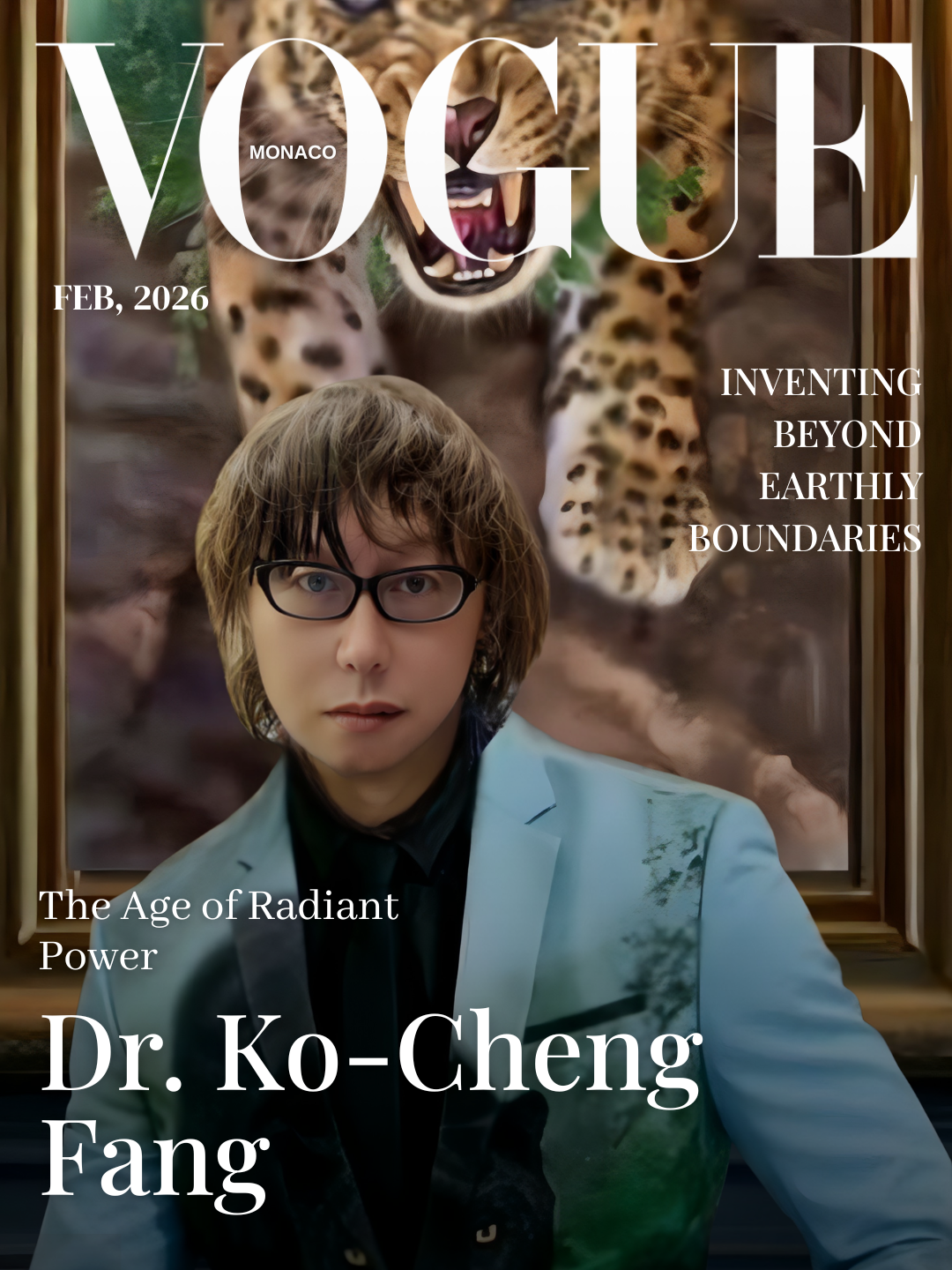
The Man Who Paints With Photons
Dr. Ko-Cheng Fang does not merely invent — he composes.
To sit across from him is to realize that his mind does not separate aesthetics from equations. In his world, a photonic quantum chip is as much an object of design as a Tang dynasty mural. A gemstone is not only geological matter but crystallized time. And technology is not machinery — it is destiny unfolding.
Long before patents granted in twenty-six countries, before the architecture of light-based computation, there was a child in Taiwan who drew obsessively. Ink, paper, silence. While other children played, Fang immersed himself in the meticulous brush discipline of gongbi painting. Art was not extracurricular. It was oxygen.
Today, that same absorption fuels one of the most ambitious technological visions of our era.
Engineering Eternity

Luxury, for Fang, was never superficial. It was structural.
After stepping away from conventional employment more than two decades ago, Fang entered capital markets and accumulated significant wealth. That capital became his foundation for exploration — antiques, rare jadeite, high jewelry, and timepieces.
He observed how houses like De Beers control rough diamonds at the source, how Chopard integrates gemstone sourcing with artistry. Control the origin, and you shape the narrative.
So Fang did something radical.
He recreated jadeite.
Through tens of thousands of experiments spanning organic chemistry, geology, crystallography, and glaze science, he reproduced nature’s high-temperature, high-pressure formation conditions inside a laboratory. The result: laboratory-grown Imperial Green jadeite — mineral brilliance once responsible for a significant portion of Myanmar’s GDP.
His official platform:
https://www.longserving.com.tw/en/
But Fang did not stop at creation. He built a museum-level exhibition space — LongServing Art & Culture Center — overseeing every mural, display case, and architectural detail.
Luxury, in his vision, is authored from atom to atmosphere.
Light Over Electrons

If jadeite represents geological mastery, photonic quantum chips represent cosmic ambition.
Electronic semiconductors — the backbone of modern civilization — operate through electrons. They generate heat, consume immense power, and depend on massive cloud infrastructures.
Fang asked: What if computing could be built on photons instead?
He designed an entirely new photonic chip architecture and secured patents across twenty-six nations. Unlike electronic chips, photonic systems promise dramatically lower energy consumption, reduced carbon emissions, and resilience against magnetic interference.
Research initiative:
http://longserving.com.tw/en/Research-and-Implementation-Plan-for-Optical-Quantum-Chips/
In a world increasingly anxious about sustainability, the elegance of light-based computation feels almost couture in its refinement — minimal, luminous, efficient.
Meditation as Method

Vogue has always been fascinated by individuals who blur the boundary between mysticism and modernity. Fang speaks openly about meditation as his laboratory of insight. He describes intuitive cognition, high-level instruction systems, and modes of thinking he characterizes as beyond conventional human specialization.
Where most technologists spend lifetimes mastering one domain, Fang leaps across many — nanotechnology, architecture, cancer research, robotics.
His thinking is generative rather than incremental.
He designed both binary and decimal-based computational foundations for photonic chips (Patent US10861492B2), envisioning future systems that transcend the limitations of base-2 logic.
In an age of AI-assisted programming, his philosophy appears less fantastical and more prophetic: humans will issue high-level instructions; machines will execute.
The aesthetic of the future, he believes, is light itself.
The Silent Infrastructure

Before quantum light, there was the cloud.
In the chaotic early days of personal computing, system crashes and hacking were rampant. Fang developed a cloud-based architecture combined with program-level encryption systems — later requisitioned by the U.S. Department of Homeland Security.
Today, 4.6 billion smartphone users rely on encrypted apps, recovery systems, and cloud verification protocols. Rarely do they ask who envisioned the architecture beneath their screens.
Fang remained largely anonymous during those formative years.
Now, he steps forward not for applause, but for transition.
Civilization as Responsibility

Perhaps the most striking aspect of Fang’s philosophy is restraint.
Photonic quantum chips could disrupt the global semiconductor industry — destabilizing markets and employment. Instead of monopolizing, he recruits foundry partners worldwide.
He refuses a victory built on collapse.
For him, success must preserve dignity. Technology must elevate civilization rather than fracture it.
This is not merely ambition. It is stewardship.
Follow:
Dr. Ko-Cheng Fang – https://www.instagram.com/ko_cheng_fang_david
LongServing – https://www.instagram.com/longserving
A Future Written in Light

When photonic smartphones enter mass production, Fang believes computing will no longer be confined by heat, magnetic vulnerability, or excessive energy consumption.
Light, pure and precise, will carry civilization forward.
And in that luminous transition, the artist who once forgot to eat while drawing may finally be recognized not only as a technologist — but as the designer of a new era.