
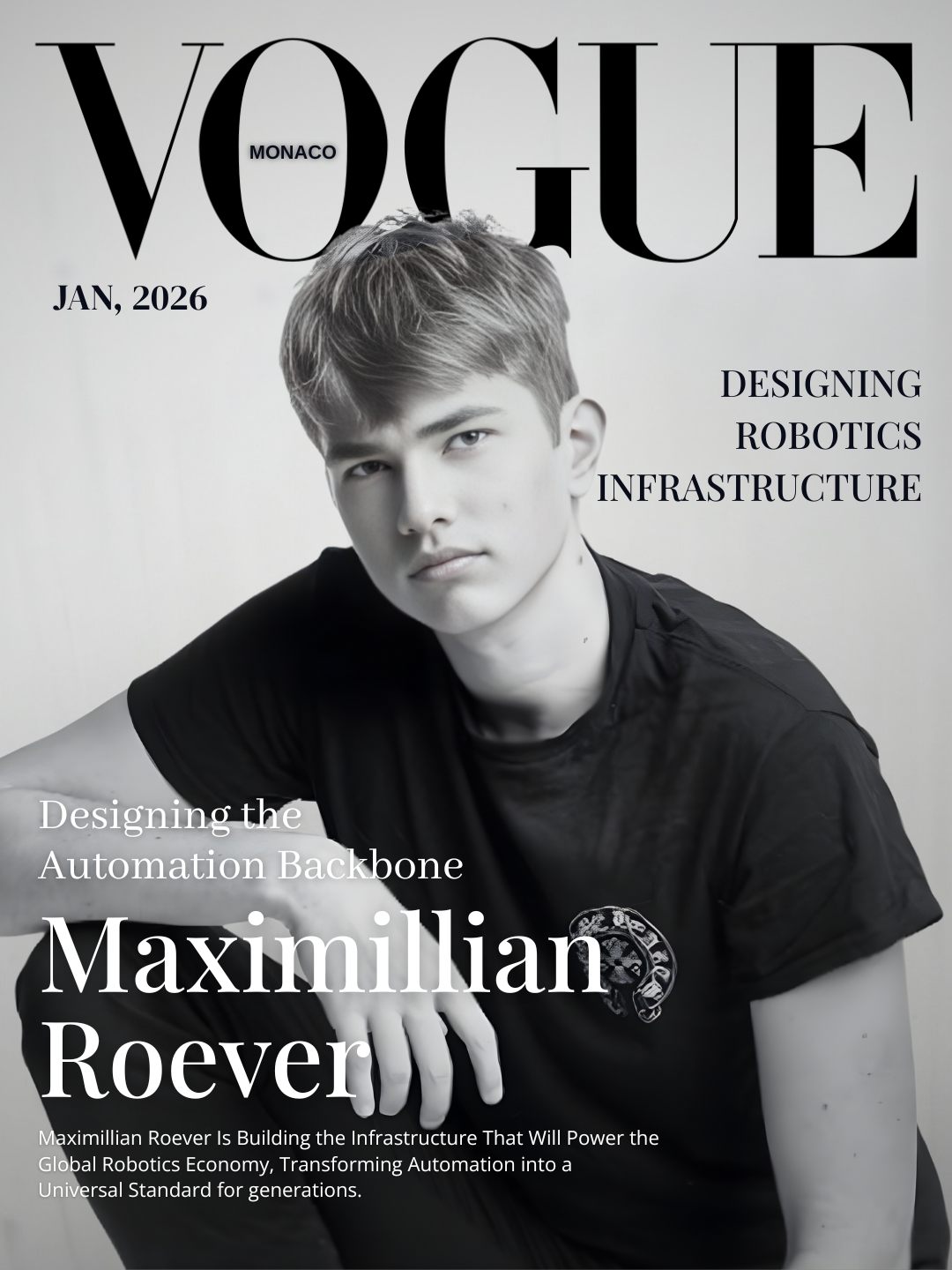
In an era where artificial intelligence is rapidly redefining how industries operate, a new class of founders is emerging — leaders who are not merely building products, but designing the underlying infrastructure of entirely new economies. Maximillian Roever is one of them.
As the founder of Polaris Exchange, Roever is pioneering a radically simpler way for enterprises to discover, evaluate, and deploy robotics at scale. His vision is bold yet practical: to make robotics as accessible, comparable, and reliable as cloud software. In doing so, he is laying the groundwork for what many believe will become the backbone of the global robotics economy.
A Foundation Built on Discipline
Long before boardrooms and product roadmaps, Roever’s education began on the basketball court.
Growing up immersed in competitive sports, he learned early that excellence is forged through discipline, repetition, and teamwork. Countless hours of practice taught him how to push through fatigue, handle pressure, and commit to long-term improvement.
“Basketball taught me discipline, teamwork, and perseverance,” Roever says. “It wasn’t just about the game — it was about showing up every day and putting in the work.”
Those lessons became permanent. Today, they show up in how he builds teams, sets standards, and approaches complex problems.
Creativity as a Strategic Advantage

While sports shaped his discipline, creativity shaped his perspective.
After practices, Roever immersed himself in music production, experimenting with beats, textures, and sound design. Music offered him a space to explore emotion, rhythm, and storytelling.
At the same time, he developed a deep interest in investing and financial markets, studying trends, business models, and macroeconomic shifts.
“Music and investing are both creative in different ways,” he explains. “One is emotion and rhythm. The other is logic and foresight.”
This blend of artistic intuition and analytical thinking would later become one of his greatest strengths as a founder.
The Road to Entrepreneurship
Roever’s move into entrepreneurship happened organically.
Conversations with friends about ideas and investments slowly evolved into deeper exploration of how companies are built. He sought out mentors, learned from experienced operators, and began connecting the dots between strategy, execution, and scale.
“I realized the same principles from sports applied to business,” he says. “Discipline, teamwork, strategy, and consistency.”
His social circle further expanded his worldview. Through friends, he discovered chess, photography, and global sports culture — sharpening his strategic thinking and appreciation for detail.
“Every person introduced me to a new way of thinking,” Roever reflects. “Those perspectives taught me that success isn’t linear — it’s built from many different experiences.”
Identifying a Structural Problem

As Roever studied emerging technologies, one contradiction stood out.
Robotics was advancing at an extraordinary pace. Yet the process of buying and deploying robots remained slow, fragmented, and opaque.
Vendors operated in isolation. Pricing lacked transparency. Enterprises struggled to compare options or validate performance.
The problem was not innovation.
The problem was infrastructure.
Roever saw that while software had marketplaces, app stores, and cloud platforms, robotics had none of the same organizational layers.
That insight became the seed for Polaris Exchange.
Building Polaris Exchange

Polaris Exchange is designed as the world’s first end-to-end robotics marketplace.
Enterprises can discover, compare, price, and deploy robotic solutions across sectors such as logistics, energy, security, and industrial services — all from a single platform.
But Polaris Exchange goes far beyond listings.
The platform supports the full lifecycle of robotics adoption, from proof-of-execution to large-scale deployment, using verified vendors, performance metrics, and real-world workflows.
Key application areas include:
- Campus logistics and autonomous delivery
- Solar farm inspection and maintenance
- Perimeter security and surveillance
- Commercial and industrial painting
- Hazardous material (HAZMAT) sorting
- Turbine inspection and sorting
By reducing friction and risk, Polaris Exchange transforms robotics from an experimental expense into a reliable operational tool.
Infrastructure for the Machine Age
Roever does not view Polaris Exchange as a typical marketplace.
He sees it as an infrastructure layer for physical intelligence.
Just as cloud platforms became the backbone of the digital economy, Polaris Exchange aims to become the backbone of the robotics economy — quietly powering how machines are selected, validated, and deployed worldwide.
“Robotics shouldn’t be mysterious,” Roever says. “It should be discoverable, comparable, and reliable.”
The company’s name reflects this mission. Polaris, the North Star, has guided explorers for centuries. Likewise, Polaris Exchange is designed to guide enterprises through the complexity of automation.
Leadership Philosophy

Roever’s leadership style is calm, focused, and long-term.
He values systems over shortcuts. Foundations over hype. Execution over noise.
His multidisciplinary background allows him to move comfortably between engineering conversations, business strategy, and creative ideation — a rare advantage in a field where innovation happens at intersections.
For Roever, success is not defined by a single breakthrough.
It is defined by consistent progress.
The Bigger Vision
As labor shortages intensify and automation becomes essential, reliable robotics infrastructure will become a necessity for global industry.
Maximillian Roever is positioning himself — and Polaris Exchange — at the center of that transformation.
Not by chasing headlines.
But by building the rails on which the next era of industrial automation will run.
In doing so, Roever is emerging as more than a founder.
He is becoming an architect of the robotics economy — designing how the physical world will be automated, one system at a time.