
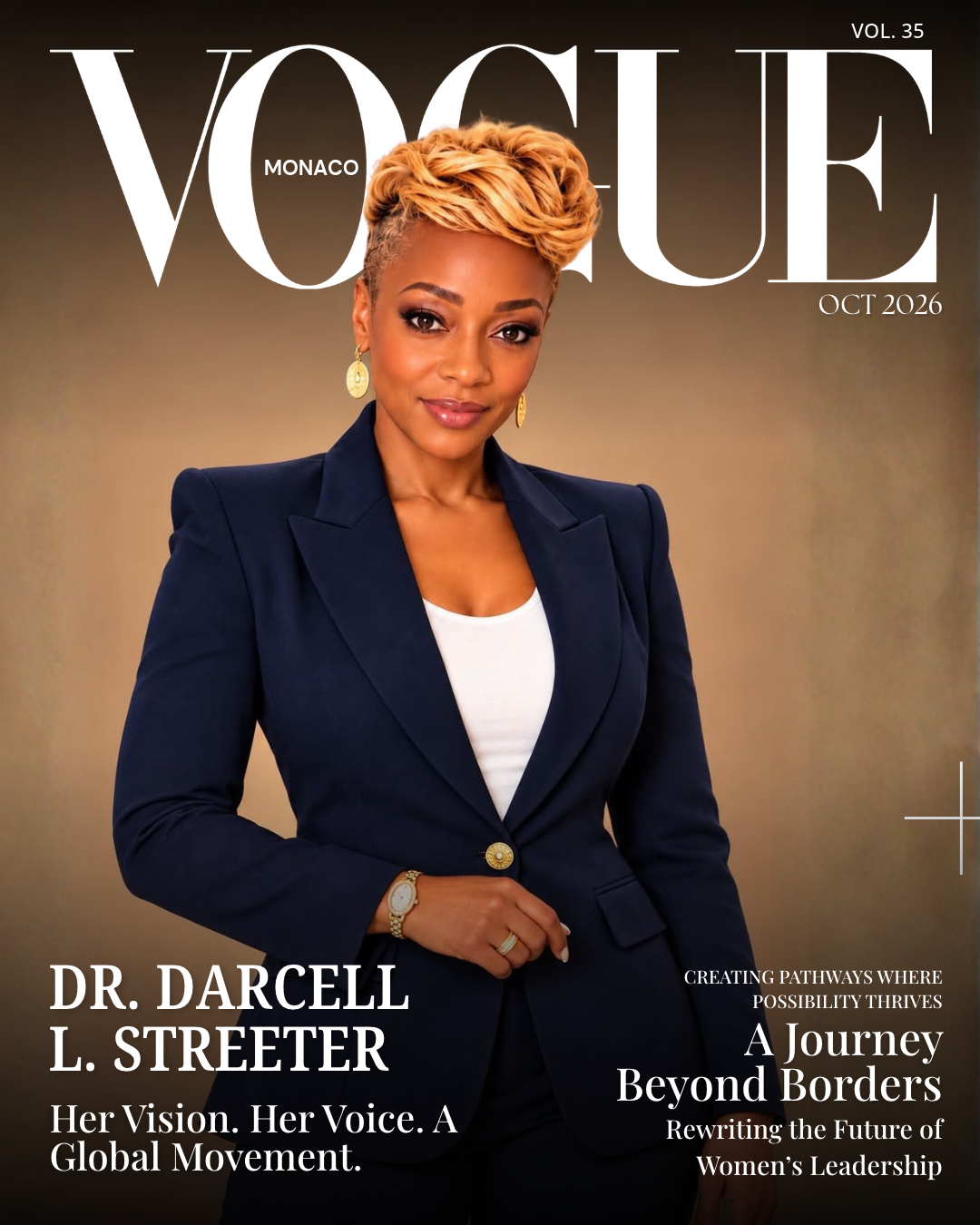
A Leadership Journey Rooted in Purpose
Leadership becomes truly transformative when it moves beyond individual achievement and creates opportunities for others to flourish. For Dr. Darcell L. Streeter, CEO of Women’s Circle, Inc. and Founder of B.HER Global™, this philosophy has become the foundation of a lifelong commitment to empowering women, reimagining education, and developing systems that recognize the dignity and potential of every individual.
Her work reflects a conviction that meaningful change cannot depend solely on inspiration or temporary interventions. It requires intentional structures, inclusive communities, and practical pathways through which people can discover their strengths and translate them into lasting progress. Through her leadership, Dr. Streeter has connected personal development with institutional innovation, building initiatives that encourage women and learners across generations to reconsider what is possible for their lives.
Her approach combines spiritual grounding, human-centered leadership, and an understanding of the social structures that influence opportunity. Rather than accepting conventional definitions of success, she has devoted her career to questioning the systems that determine who receives access, recognition, and the freedom to develop their capabilities.
For Dr. Streeter, transformation begins with an individual recognizing their own value. Its broader significance emerges when that recognition becomes embedded in the communities, educational environments, and organizations that shape future generations.
The Experiences That Shaped Her Perspective
Discovering the Meaning of Service
Dr. Streeter’s professional philosophy developed through experiences that connected personal responsibility with a wider sense of purpose. Her upbringing encouraged her to understand service not as an occasional gesture but as a fundamental expression of character. This early orientation influenced the way she approached education, relationships, and leadership.
Her academic foundation in Biblical Studies provided a framework for examining questions of morality, responsibility, faith, and the obligations individuals have toward one another. These principles later became important reference points in her understanding of organizational leadership. For her, professional accomplishment carries greater meaning when it remains connected to ethical conduct and the well-being of others.
She subsequently pursued graduate studies in Human Services, expanding her understanding of the relationship between individual circumstances and the institutions surrounding them. This field of study exposed her to the complex realities that influence people’s access to support, education, stability, and personal development.
The combination of spiritual education and human services helped shape a leadership perspective that considers both individual agency and structural conditions. People may possess remarkable abilities, yet their opportunities can be restricted by environments that fail to recognize their potential. Addressing these limitations requires more than encouraging individuals to work harder; it also demands a willingness to examine and improve the systems in which they operate.
These insights became central to Dr. Streeter’s subsequent work, informing her commitment to creating environments where individuals are supported in developing their capabilities rather than being defined by the limitations imposed upon them.
Learning Across Different Worlds
Geography also played an important role in shaping her understanding of people and communities. At nine years old, she experienced a major transition when her mother relocated the family from Birmingham, Alabama, to Seattle, Washington. Moving between these distinct cultural environments exposed her to different social experiences and ways of interpreting the world.
The transition encouraged her to recognize that the assumptions people develop within one environment do not necessarily apply everywhere. Differences in culture, community, and lived experience can influence how individuals understand identity, opportunity, and belonging.
Her mother’s example provided another lasting lesson. Through her faith and everyday actions, she demonstrated the importance of maintaining conviction while navigating change. Dr. Streeter came to understand belief not simply as an abstract principle but as something expressed through consistent decisions and conduct.
At sixteen, she returned to Alabama to live with her father. His emphasis on responsibility and accountability further shaped her understanding of commitment. The influence of both parents contributed to a perspective that combines faith with practical responsibility, compassion with discipline, and aspiration with follow-through.
These experiences gave her a broader appreciation of the many factors that shape human development. They also strengthened her belief that effective leadership must remain attentive to the cultural and personal realities of the people it serves.
Turning Discrimination Into a Commitment to Change

An Encounter That Challenged Her Sense of Possibility
One of the defining experiences in Dr. Streeter’s life occurred when she was sixteen. During her school years, an administrator told her that Black people did not need an education. The statement represented more than an offensive personal remark; it reflected a discriminatory assumption about who deserved access to knowledge and advancement.
Such an encounter could have undermined her confidence or narrowed her expectations for the future. Instead, it became an experience she would spend years examining as she developed a deeper understanding of identity, self-worth, and the influence of external narratives.
The incident forced her to confront an unsettling question: How much of a person’s understanding of themselves is shaped by messages communicated through authority figures and established institutions?
Dr. Streeter recognized that repeated exposure to limiting beliefs can influence the way individuals evaluate their own abilities. When society communicates that certain people are less deserving of opportunity, those messages can become internal obstacles even when the individuals concerned possess the talent and determination to succeed.
Her response was to challenge the underlying assumption rather than accept its implications. She began to see that personal worth should not depend on institutional approval, academic recognition, professional status, or the willingness of others to acknowledge one’s potential.
This distinction became a significant element of her leadership philosophy. Achievement can demonstrate capability, but it does not create a person’s inherent dignity. Individuals should not have to prove that they deserve respect before they can claim it.
From Personal Reclamation to Collective Empowerment
Over time, Dr. Streeter’s reflections on identity developed into a broader purpose: helping people question the narratives that restrict their understanding of themselves.
Her work recognizes that empowerment involves more than delivering motivational messages. Individuals need opportunities to examine their experiences, develop healthier perspectives, strengthen their decision-making, and participate in environments that affirm their humanity.
This understanding informs her commitment to building communities and frameworks that encourage women to move beyond inherited expectations. Instead of treating personal difficulties as evidence of inadequacy, her approach creates space for people to understand their experiences, identify their strengths, and make intentional decisions about their futures.
The significance of this work extends beyond individual confidence. When women gain a stronger understanding of their abilities and values, they can participate more fully in professional, educational, and community settings. Their development can influence families, workplaces, and the opportunities available to others.
Dr. Streeter’s response to discrimination therefore reaches beyond the experience that inspired it. Her larger objective is to help create conditions in which limiting assumptions are challenged through education, leadership, and practical systems that expand access to opportunity.
Developing a Framework for Personal Transformation
The BECOMING HER™ Methodology
Among Dr. Streeter’s central contributions is BECOMING HER™, an eight-step framework designed to guide individuals through healing, identity alignment, and empowered leadership.
The framework reflects her belief that sustainable development requires a deliberate process. Encouragement may help someone recognize the possibility of change, but lasting progress also requires reflection, intentional choices, and practices that support continued growth.
By organizing personal development into a structured pathway, BECOMING HER™ seeks to provide individuals with a framework through which they can examine their experiences and approach their next stages of life with greater clarity.
Its emphasis on healing acknowledges that previous experiences can influence present decisions. Identity alignment encourages individuals to consider whether their actions reflect their values and aspirations. Empowered leadership extends that personal understanding into the way people make decisions, engage with others, and contribute to their communities.
The framework also reflects an important principle in Dr. Streeter’s work: development should not create unnecessary dependence on a single mentor, organization, or source of encouragement. Effective guidance equips individuals with tools they can continue using independently.
By focusing on transferable principles, BECOMING HER™ connects personal growth with practical leadership. Its broader ambition is to help participants move from understanding their own potential to exercising that potential in ways that create meaningful outcomes for others.
Making Leadership Accessible and Sustainable
Dr. Streeter’s work through B.HER Global™ complements her wider commitment to expanding opportunities for women. Her leadership recognizes that empowerment must be supported by structures that allow people to apply what they learn.
This means looking beyond temporary moments of inspiration toward the development of knowledge, relationships, and systems that can continue serving people over time.
Her philosophy places particular importance on helping individuals become active participants in their own development. Rather than positioning women as passive recipients of assistance, the emphasis is on cultivating their capacity to make decisions, exercise leadership, and contribute to the environments around them.
Such an approach also challenges the assumption that meaningful leadership belongs exclusively to people who already occupy influential positions. Leadership can emerge wherever individuals take responsibility, recognize the needs of others, and use their capabilities to improve shared circumstances.
Through this perspective, personal development becomes a foundation for wider participation. The objective is not simply to help women succeed within existing structures but to prepare them to influence how those structures operate.
Circle Forward: Rethinking the Future of Education
Building a Learning Environment Without Traditional Boundaries
Dr. Streeter’s educational vision takes shape through Circle Forward: The Global Life and Learning Hub, an initiative being developed through Women’s Circle, Inc.
The proposed model approaches education as a connected system in which knowledge, practical capabilities, cultural understanding, and intergenerational learning reinforce one another. Designed as a multilingual and multigenerational micro-school concept, Circle Forward aims to create learning opportunities for young people and adults within a shared educational environment.
Its emphasis on STEAM disciplines, vocational pathways, and life skills reflects an understanding that learners require different combinations of knowledge to navigate contemporary life. Academic instruction remains important, but so do practical competencies, adaptability, communication, and the ability to apply learning to real-world situations.
The model also emphasizes cultural responsiveness. Learners bring different languages, traditions, experiences, and perspectives into educational spaces. An inclusive system should recognize these differences as meaningful elements of the learning process rather than treating them as obstacles to standardization.
By connecting people across generations, Circle Forward envisions an environment in which knowledge can move in multiple directions. Younger learners may bring new technological perspectives, while adults contribute professional experience, community knowledge, and practical wisdom.
This approach positions education as a continuing process of exchange rather than an experience confined to a particular age group or stage of life.
Integrating Technology, Credentials, and Community
Circle Forward is envisioned as more than a collection of educational programs. Its proposed infrastructure includes a proprietary digital operating system, a micro-credentialing ecosystem, and a regional hub structure supported by a train-the-trainer model.
The digital component is intended to support the coordination and delivery of learning. Micro-credentials offer a potential mechanism for recognizing specific competencies and learning achievements, while regional hubs could support the development of local capacity.
The train-the-trainer approach is particularly significant to the initiative’s ambitions for expansion. By preparing individuals to facilitate learning and transmit established practices, the model seeks to create opportunities for implementation beyond a single location.
Its wider vision resembles a circular knowledge economy in which learning, teaching, mentorship, and community participation continually reinforce one another. Knowledge is not simply delivered and consumed; it is developed, applied, shared, and adapted to different contexts.
Achieving this vision will depend on effective implementation, sustainable resources, strong educational partnerships, and the ability to evaluate outcomes across diverse communities. Nevertheless, the concept establishes a clear direction: educational systems can be designed to recognize cultural identity, encourage lifelong learning, and support broader participation in opportunity.
For Dr. Streeter, the potential of Circle Forward lies in creating an adaptable model that can serve different populations without losing sight of the people at its center.
A Decision-Making Philosophy for Complex Challenges
The PAWS System™

Dr. Streeter’s leadership approach also includes the PAWS System™, an acronym for Pause, Assess, Witness, Shift. The framework provides a structured method for responding to difficult situations without allowing urgency or external pressure to dictate every decision.
The first stage, Pause, creates space between a challenge and the response it demands. Rather than reacting immediately, a leader takes time to regain perspective and clarify what requires attention.
Assess involves examining the wider circumstances. This includes identifying the people affected, understanding the institutional or social forces influencing the situation, and determining whether potential actions remain consistent with the organization’s mission.
Witness calls for attentive observation without premature judgment. It encourages leaders to consider evidence, listen to those involved, and recognize that lived experience can reveal dimensions of a problem that formal data alone may not capture.
The final stage, Shift, translates reflection into deliberate action. After examining the situation, the leader determines what needs to change and proceeds with greater clarity and intention.
Together, these stages encourage disciplined responses to uncertainty. They offer a way to balance careful consideration with the responsibility to act.
Principles That Guide Difficult Decisions
The PAWS System™ operates alongside four principles that Dr. Streeter identifies as central to her work: dignity, accountability, cultural responsiveness, and service.
Dignity requires treating people as individuals whose worth does not depend on their circumstances or performance. Accountability connects intentions with responsibility for decisions and their consequences. Cultural responsiveness acknowledges the importance of understanding the experiences and contexts that influence people’s lives. Service keeps leadership oriented toward contribution rather than personal authority.
These principles provide a foundation for navigating competing priorities. They also reinforce her understanding that effective leadership is not simply a matter of reaching objectives. The manner in which those objectives are pursued matters just as much.
As an ordained minister, Dr. Streeter views leadership through the lens of stewardship. Influence carries obligations, and authority should be exercised with consideration for the people and communities entrusted to a leader’s care.
Building Systems That Can Outlast Their Founder
A recurring theme throughout Dr. Streeter’s work is the importance of creating structures that remain useful beyond the involvement of their original architect.
Her frameworks, educational initiatives, and written work reflect an interest in making knowledge transferable. The goal is to establish principles and methods that other people can understand, apply, and adapt rather than concentrating expertise within a single individual.
This philosophy is evident in her book, Reflections of Becoming HER: Healed. Effective. Reigning. The publication brings together aspects of her personal and professional reflections, offering readers an opportunity to engage with ideas surrounding identity, development, and leadership.
Writing also provides a means of extending the reach of an individual’s experience. Ideas recorded in a book can be revisited, discussed, and interpreted by readers who may never encounter the author directly.
For Dr. Streeter, this form of knowledge-sharing aligns with her wider interest in sustainable impact. A successful initiative should create the conditions for others to develop their own capabilities, assume responsibility, and contribute to future progress.
Her approach consequently places value on institutional continuity, practical frameworks, and the development of people who can carry ideas forward. The aspiration is to build an ecosystem in which progress does not depend entirely on one person remaining present.
Measuring Success Through Human Impact
Although Dr. Streeter’s work includes organizational leadership, educational innovation, and the development of structured methodologies, she identifies the women whose lives have been influenced by Women’s Circle as her most meaningful achievement.
Over approximately twenty-five years of building the organization, she has focused on creating spaces where women can reconsider their experiences, recognize their capabilities, and develop a stronger sense of direction.
The significance of such work cannot be fully captured through organizational titles or the number of programs established. Its deeper value lies in whether people gain the confidence, understanding, and practical resources to make meaningful decisions about their lives.
Dr. Streeter is particularly proud of the women who have entered these communities feeling depleted, uncertain, or disconnected and subsequently developed a clearer understanding of their own worth. Their experiences represent the human purpose behind the frameworks and initiatives she has worked to establish.
Her honorary doctorate in Christian Leadership and Business represents another milestone in her professional journey. Yet her stated priorities suggest that recognition matters most when it supports a larger mission of service and community development.
This emphasis on people provides a useful lens through which to understand her leadership. Programs and systems are important, but they ultimately exist to serve human needs. Their success depends on whether they create meaningful opportunities and contribute to lasting improvements in people’s lives.
Looking Toward the Next Frontier
Dr. Streeter’s future ambitions connect her existing work with emerging questions about technology, education, and inclusion. She aspires to complete her doctoral research and contribute to scholarship at the intersection of artificial intelligence and culturally responsive design.
This area of interest raises important questions about how emerging technologies can be developed and implemented in ways that recognize different cultural contexts and learning needs. Digital systems can expand access to information and services, but their effectiveness also depends on whether they account for the diversity of the people expected to use them.
Her interest in this field is consistent with her broader philosophy: innovation should be evaluated not only by what technology makes possible but also by whom it serves and how thoughtfully it responds to human experience.
She also hopes to see Circle Forward operating at a global scale. Realizing that ambition will require translating its educational principles into sustainable practices across different communities, languages, and institutional environments.
The challenge will be to balance scalability with cultural relevance, maintaining a coherent educational vision while allowing local communities to shape its implementation.
If successful, the initiative could offer a model for connecting lifelong learning, community participation, and practical skill development through an adaptable infrastructure.
A Legacy Defined by What Others Can Become
Dr. Darcell L. Streeter’s journey brings together experiences of discrimination, lessons in faith and accountability, academic preparation, and a sustained commitment to human development. These influences have shaped a leadership philosophy that connects individual dignity with the responsibility to improve the systems surrounding people.
Through Women’s Circle, Inc., B.HER Global™, BECOMING HER™, and the developing Circle Forward initiative, she is working toward an approach to empowerment that combines personal transformation with educational and organizational innovation.
Her contribution is not limited to encouraging individuals to imagine different futures. It also involves developing frameworks through which those possibilities can be explored, practiced, and extended to others.
The enduring significance of her work will rest on the capacity of these initiatives to strengthen communities, expand access to learning, and equip people to lead with greater confidence and responsibility.
For Dr. Streeter, the ultimate measure of leadership is not how much influence one person accumulates, but how many others gain the tools to shape their own paths. It is a vision in which education opens doors, identity becomes a source of strength, and institutions are designed around human potential rather than inherited limitations.
Her work continues to advance a fundamental proposition: when people are given the opportunity to understand their worth and participate in systems that respect it, transformation becomes more than an individual achievement. It becomes the foundation for a more inclusive and capable future.