
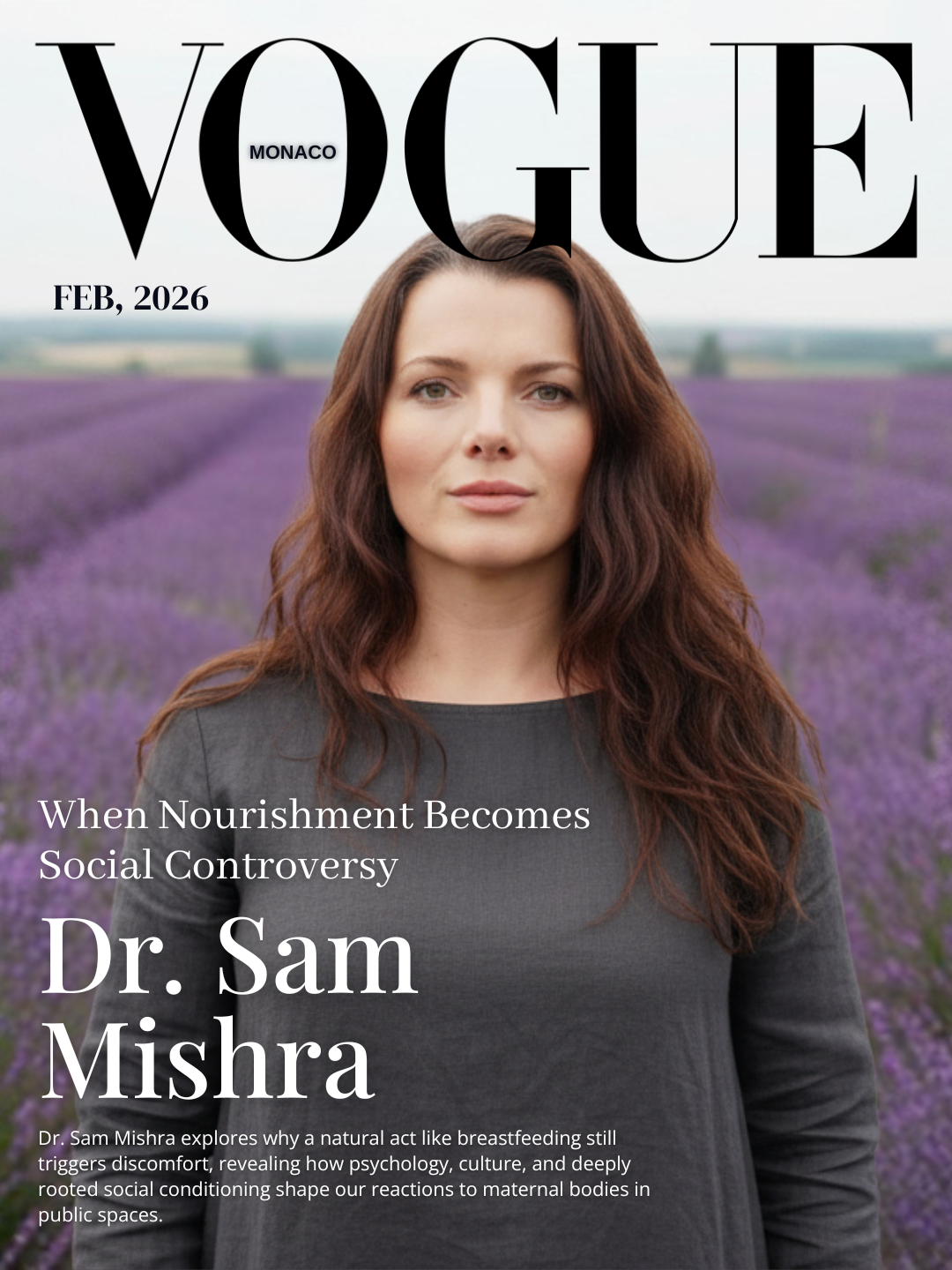
Introduction: A Natural Act, A Cultural Discomfort
For Dr. Sam Mishra, the discomfort surrounding public breastfeeding is not about the act itself—it is about what society has been taught to feel. Breastfeeding, one of the most fundamental biological functions essential for infant survival and bonding, continues to provoke reactions ranging from acceptance to visible disgust.
According to Dr. Sam Mishra, this contradiction reveals something deeper than personal preference. It reflects a complex intersection of psychology, cultural conditioning, and long-standing anxieties about the female body in public spaces. What should be understood as care is often interpreted as exposure. What is biologically normal is culturally contested.
Understanding this tension requires looking beyond the surface—into the emotional systems, learned behaviors, and social structures that shape how people respond.
The Psychology of Disgust: A Misfiring System

Dr. Sam Mishra explains that disgust is not random—it is an evolved emotional response designed to protect human beings. Historically, it helped us avoid disease, contamination, and threats to survival. However, in modern contexts, this system often misfires.
Breastfeeding can unconsciously activate what psychologists call “core disgust.” The presence of bodily fluids—even something as safe and natural as breast milk—can trigger automatic discomfort. These reactions occur before logic has a chance to intervene.
Dr. Mishra highlights that this is not because breastfeeding is harmful, but because the human brain is wired to respond quickly to anything associated with bodily exchange. The result is a visceral reaction that people often mistake for a justified moral stance.
At the same time, another layer emerges—what researchers call “animal-reminder disgust.” Breastfeeding reminds observers of human biology in its most primal form. It breaks the illusion that humans are separate from nature, forcing a confrontation with our identity as living, physical beings.
For many, this discomfort is not about the act—it is about what the act represents.
Sexualization and Cognitive Conflict
One of the most significant insights from Dr. Sam Mishra’s analysis lies in the sexualization of breasts.
In many modern societies, breasts are no longer viewed primarily as organs for feeding infants. They are framed as sexual objects—central to attraction, identity, and desirability. This cultural conditioning creates a powerful conflict when breasts are used for their biological purpose in public.
Dr. Mishra describes this as cognitive dissonance.
The brain struggles to reconcile two opposing meanings:
- Breasts as sexual
- Breasts as maternal
When these meanings collide, discomfort emerges. In some cases, that discomfort escalates into disgust.
There is also a deeper, often unspoken layer. The presence of an infant at the breast forces an immediate shift away from sexual interpretation—but for individuals conditioned to see breasts sexually, that shift is not always seamless. The confusion itself becomes unsettling.
Dr. Mishra emphasizes that this reaction is learned, not natural. It is the result of years of cultural messaging—not an inherent truth about the body.
Public Space and the Female Body

Dr. Sam Mishra further explores how public breastfeeding challenges long-standing ideas about who belongs in public space—and how.
Historically, public spaces have been shaped by male presence, while female bodies have been regulated, monitored, and often restricted. When women enter public spaces, especially in visibly maternal roles, they disrupt these expectations.
Breastfeeding makes motherhood visible.
It brings into public view something many cultures prefer to keep private—the physical, demanding, and deeply embodied nature of caregiving. According to Dr. Mishra, this visibility creates discomfort because it challenges the idea that female bodies in public should be controlled, aesthetic, and non-disruptive.
A breastfeeding mother does not conform to these expectations. Her body is functional, responsive, and centered on care—not on appearance or approval.
This shift in purpose can feel unsettling in cultures that prioritize how women’s bodies are seen over what they do.
Modesty, Morality, and Double Standards
Dr. Sam Mishra also highlights the role of modesty norms in shaping reactions to public breastfeeding.
In many societies, female modesty is tied to morality. Covering the body is associated with respectability, while exposure—even in non-sexual contexts—is often judged harshly. Breastfeeding, therefore, becomes framed as a violation of these norms.
But Dr. Mishra points out a critical contradiction.
The same cultures that object to breastfeeding often have no issue with the sexual display of breasts in advertising, media, and entertainment. This reveals that the discomfort is not truly about exposure—it is about context and control.
Breasts displayed for consumption are accepted.
Breasts used for nourishment are questioned.
This double standard exposes a deeper issue: discomfort with women exercising autonomy over their bodies outside of socially approved roles.
Cultural Conditioning and Learned Disgust

Dr. Sam Mishra emphasizes that disgust toward public breastfeeding is not universal—it is learned.
In many cultures, breastfeeding in public is entirely normalized. It does not attract attention, judgment, or discomfort. Children grow up seeing it as a natural part of life, and therefore, they do not associate it with shame or indecency.
In contrast, societies where breastfeeding is hidden or rarely seen create a cycle of unfamiliarity. What is not visible becomes unusual. What is unusual becomes uncomfortable.
Dr. Mishra explains that this is how social learning works. People absorb cues from their environment—family reactions, media portrayals, and public discourse—and internalize them as truth.
Over time, these learned reactions feel instinctive, even though they are culturally constructed.
Intersection of Identity and Bias
Another critical dimension in Dr. Sam Mishra’s analysis is how responses to public breastfeeding vary depending on who is breastfeeding.
Not all women are judged equally.
Women of color, younger mothers, and those who do not fit conventional beauty standards often face stronger negative reactions. These responses are shaped by existing social biases, including racism, classism, and body discrimination.
Dr. Mishra notes that disgust, in these cases, becomes a tool of social control. It reinforces hierarchies by signaling which bodies are acceptable in public and which are not.
This reveals that the issue is not just about breastfeeding—it is about power, visibility, and whose bodies are allowed to exist without scrutiny.
Disgust as Social Enforcement
According to Dr. Sam Mishra, disgust plays a powerful role in maintaining social norms.
Unlike rational disagreement, disgust feels immediate and unquestionable. It does not ask for justification—it presents itself as truth. This makes it an effective tool for enforcing cultural rules.
When people express disgust toward public breastfeeding, they are not just reacting—they are signaling. They are reinforcing what they believe is acceptable behavior and aligning themselves with social expectations.
Dr. Mishra explains that this is why these reactions can be so strong and resistant to change. Disgust is not just personal—it is social.
Changing the Narrative

Despite these challenges, Dr. Sam Mishra believes that attitudes toward public breastfeeding can and are changing.
One of the most effective tools is visibility. As breastfeeding becomes more common in public spaces, the sense of unfamiliarity begins to fade. What once felt unusual becomes normal.
Education also plays a key role. Understanding the biological purpose of breastfeeding helps shift perception from exposure to care. When people see breastfeeding as nourishment rather than display, the emotional response begins to change.
Equally important is challenging the broader sexualization of the female body. Dr. Mishra emphasizes that as long as breasts are viewed primarily through a sexual lens, discomfort will persist.
Reframing the body as functional—not just aesthetic—creates space for acceptance.
Conclusion: Rethinking Disgust
For Dr. Sam Mishra, the discomfort surrounding public breastfeeding is not a reflection of the act itself, but of the systems that shape perception.
Disgust, in this context, is not truth—it is conditioning.
It is the product of learned associations, cultural narratives, and social anxieties about bodies, gender, and space.
By understanding these mechanisms, society gains the opportunity to question them.
Because at its core, breastfeeding is not controversial. It is not indecent. It is not disruptive.
It is care.
And as Dr. Sam Mishra makes clear, the path forward lies not in hiding this act—but in understanding why it was ever questioned in the first place.