
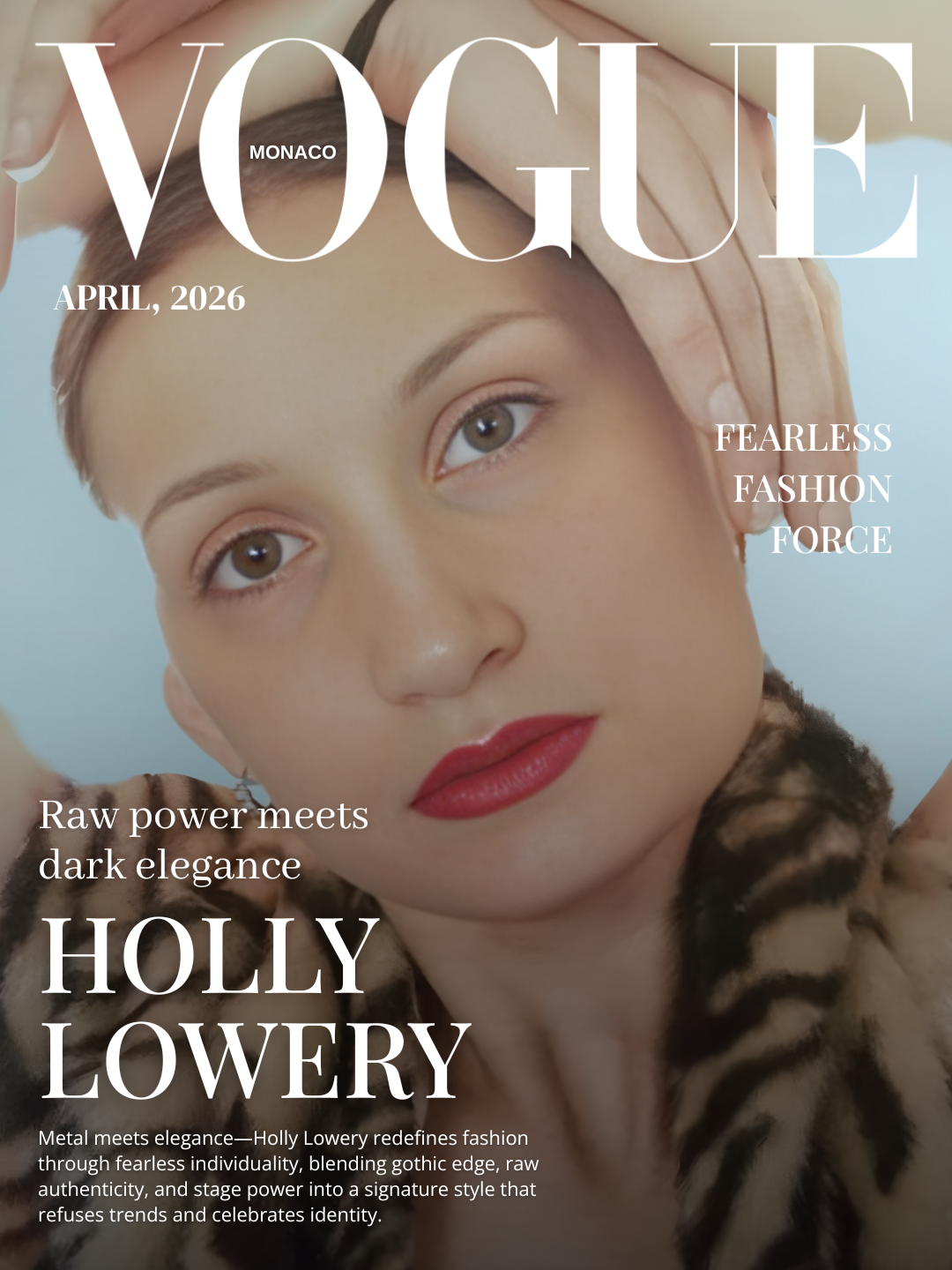
The first thing one notices about Holly Lowery is not simply her voice, but the undeniable presence she carries, a presence that extends far beyond sound and into a carefully constructed visual identity that commands attention with equal force. In a genre traditionally defined by music alone, Holly has established a fashion language that is not secondary to her artistry, but intrinsically connected to it, existing as a bold, unapologetic, and deeply personal extension of who she is.
Raised in Greeneville, Holly grew up surrounded by the cultural textures of traditional Americana, yet even within that environment there existed a quiet pull toward individuality that would later define her entire aesthetic direction. Her style did not emerge from trend cycles or seasonal influence, but from an evolving sense of self, shaped by experience, instinct, and an unwavering commitment to authenticity.
That transformation took a decisive turn when heavy music entered her life, influenced early on by her father’s appreciation for bands like Black Sabbath, and later expanded through the visual and cultural impact of Headbangers Ball, which introduced her to a world where fashion and music were inseparable, where leather, lace, metal, and darkness were not merely stylistic choices but symbols of identity, rebellion, and belonging.
What distinguishes Holly is not the influence itself, but the way she reinterprets it, refusing imitation in favor of evolution, gradually shaping a look that exists at the intersection of gothic elegance and industrial edge, where corsets meet combat boots, where structured leather contrasts with flowing lace, and where chains are layered with intention rather than excess, creating a visual language in which every element carries meaning and contributes to a cohesive identity.
Her fashion reflects the same duality that defines her voice, moving seamlessly between softness and intensity, between refinement and raw power, mirroring her ability to transition from soprano clarity to the aggressive force required for metal vocals, resulting in a presence that is both commanding and intricate, both controlled and unrestrained.
On stage, Holly understands that visibility is a form of authority, particularly within a genre historically dominated by male artists, and her fashion becomes a deliberate assertion of that presence, with silhouettes that are fitted, bold, and intentionally designed to occupy space without apology, ensuring that her visual identity holds the same weight as her sound.
Away from the stage, her aesthetic becomes more understated while remaining entirely consistent with her core identity, with black serving as a constant foundation, often layered with textured fabrics and worn-in pieces that reflect years of movement, travel, and lived experience, creating a wardrobe that feels authentic rather than constructed, shaped by life rather than styled for perception.
Touring played a defining role in refining this approach, as life on the road demanded a balance between practicality and expression, requiring clothing that could withstand long nights, intense performances, and constant transitions between environments, ultimately leading Holly to develop a style that merges durability with visual impact, where functionality becomes an integral part of the aesthetic rather than a compromise.
This balance is evident in every detail, from boots selected not only for their visual strength but for their endurance, to fabrics chosen for their ability to move and breathe under stage conditions, to layered compositions designed to transition seamlessly from backstage environments to live performance, reflecting a deep understanding of both form and function.
Beyond its physical elements, Holly’s fashion is rooted in a clear philosophy centered on resistance to conformity, particularly within an industry that often places pressure on artists to adopt commercially viable images, a pressure she has consistently refused, choosing instead to remain aligned with her identity rather than external expectations.
This same principle defines her music, where she has resisted attempts to make her work more accessible at the cost of authenticity, a decision that extends naturally into her visual presentation, ensuring that her fashion remains an honest reflection of self rather than a curated image designed for approval.
Her experiences across cities such as Los Angeles, New York, Florida, and Iowa have introduced her to a wide range of influences, yet none have altered her core aesthetic, instead reinforcing her commitment to individuality and clarifying the boundaries of her identity within an ever-changing cultural landscape.
Within the metal community, her style aligns seamlessly with its deeper values of loyalty, resilience, and resistance to conformity, a perspective further reinforced through her connections with bands such as Trivium, Slipknot, and Motörhead, where image is not about perfection but about truth, and where authenticity carries more weight than polish.
For Holly, truth is never refined into something artificial, but instead exists in its raw, layered, and lived form, expressed through a fashion identity that reflects decades of experience across stages, studios, and cities, with every piece carrying a sense of history that cannot be replicated.
Today, Holly Lowery stands not only as a musician but as a visual force within the metal space, embodying an understanding that fashion, like music, possesses the ability to communicate meaning without words, creating a presence that resonates beyond performance alone.
In a world increasingly shaped by fleeting trends and curated perfection, her style remains grounded in something far more enduring, a commitment to authenticity that refuses compromise and prioritizes truth above all else, ultimately reinforcing a simple but powerful idea that defines her entire approach.
For Holly, fashion is not about being seen, but about being understood.