
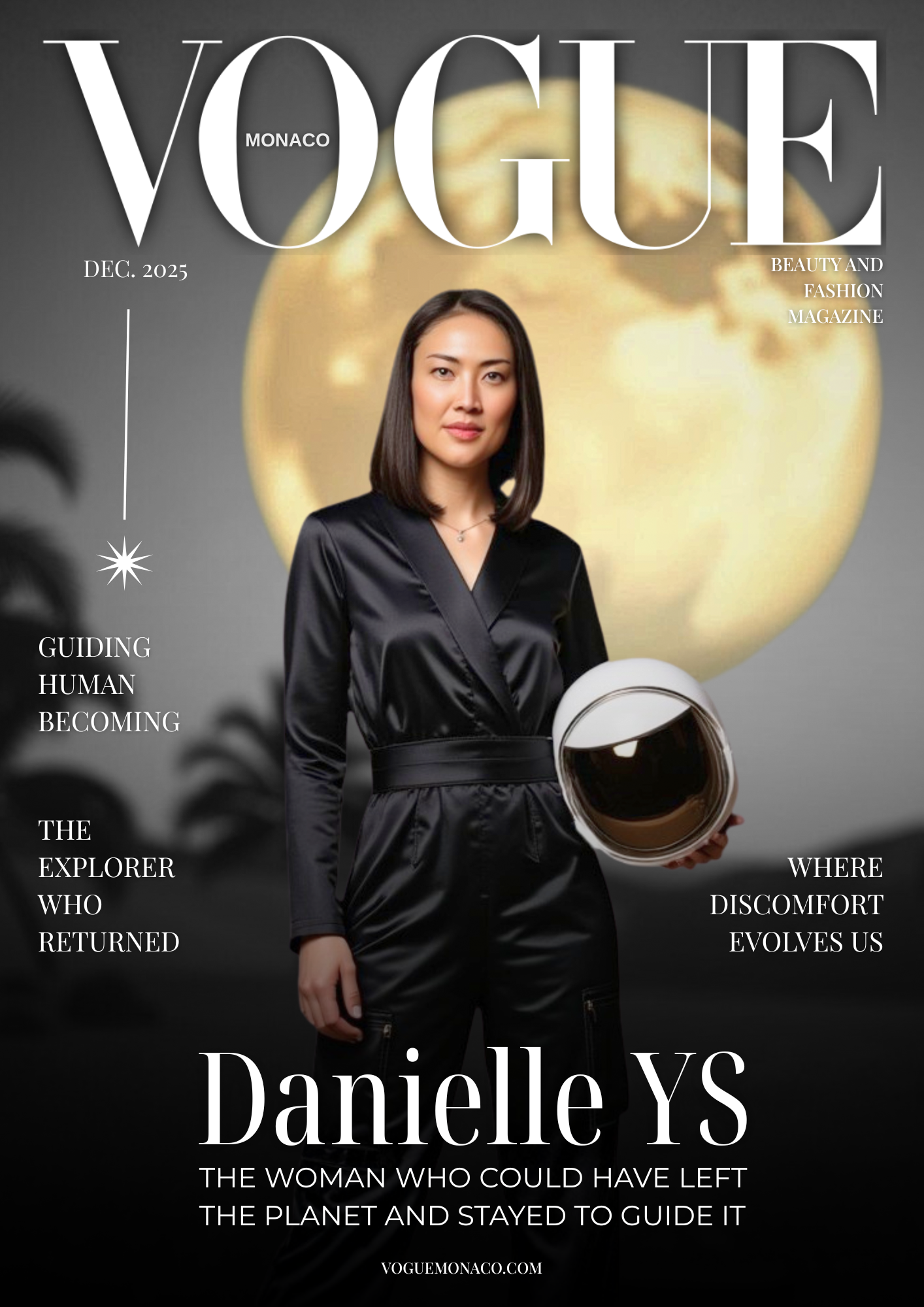
Vogue Monaco
An exclusive Vogue Monaco × Becoming Legendary by Rita Valente
There’s a particular kind of night that makes you believe in portals.
Snow falls quietly, the world turns hushed, and a child slips outside as if she’s answering a secret invitation. She doesn’t build a snowman. She doesn’t rush to warm hands. She lies down in the bushes, letting the cold cradle her bones, watching flakes drift toward her face like stardust. In her mind, she isn’t in a backyard—she’s soaring through space to another planet, rehearsing the feeling of leaving Earth without ever leaving home.
That child grows up to become Danielle YS — the woman people would later nickname without asking: space girl, NASA girl, astronaut girl.
The kind of woman who, when she fills out her university applications, writes astrophysics with the clean certainty of someone choosing a destiny. Not because it’s easy—but because it’s hard. Because exploration, for her, has always been synonymous with becoming.
And yet, the most radical thing she ever did wasn’t to reach for the stars. It was to turn back toward our planet—toward the interior cosmos most people spend their entire lives avoiding.
Escapists and Explorers
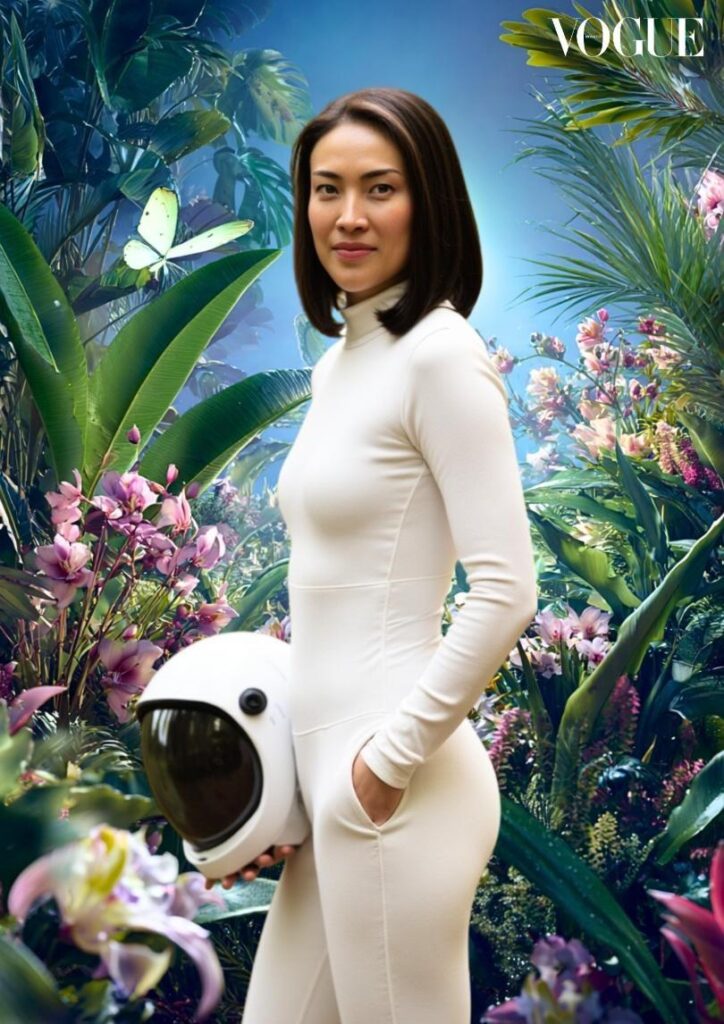
She frames the world in a way that instantly rearranges your own story.
“There are two kinds of people,” she begins: escapists and explorers. Explorers thrive at the edge of uncertainty; escapists cling to control to stay safe.
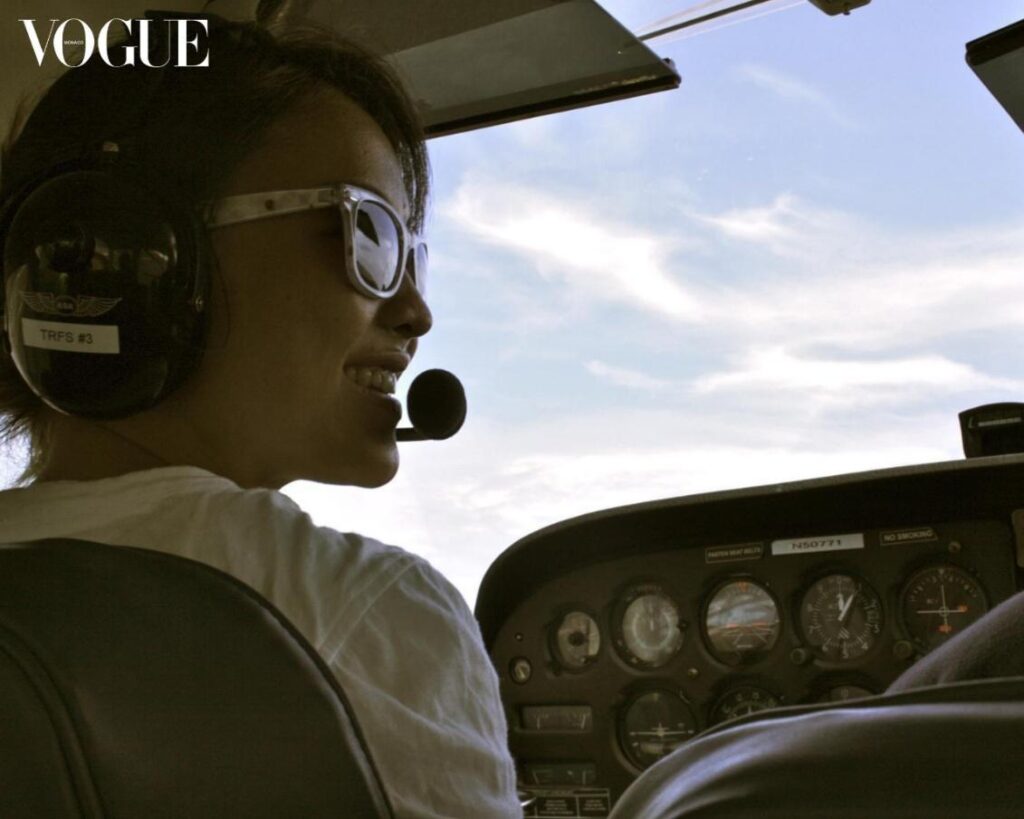
In her original blueprint, space was the final frontier—an ultimate proving ground for an explorer’s spirit. She chose astrophysics, then took the prescribed steps that orbit big dreams: internships, research, field study, advanced credentials, the long runway to applying for the Astronaut Corps.
Then—because life has its own sense of timing—she stepped off the path.
She unenrolled from university to “reset” and figure out who she actually wanted to be. And
two hours later, she was accepted into a NASA internship.
The Universe has a way of answering the exact version of you that’s brave enough to
change course.
NASA, SETI, and The Seeds of a Philosophy
At NASA and within the SETI ecosystem—the Search for Extraterrestrial Intelligence—she studied the origins of evolution.
Not in a romantic, metaphorical sense, but through the meticulous stress-testing of life itself. The work involved algae—organisms pushed to their limits to see what happens when survival demands adaptation.
It was here that the concept she would later teach to thousands began to form: stress is not a good thing or a bad thing—it’s an evolutionary thing. A signal that we’re ready to evolve—if we can meet that signal without overwhelming our systems.
She calls it The Discomfort Advantage.
A phrase that sounds like a leadership mantra until you understand the science-laced tenderness behind it: the idea that growth is not found in comfort, but in learning how to stand at the threshold—stressed enough to transform, supported enough to stay present.
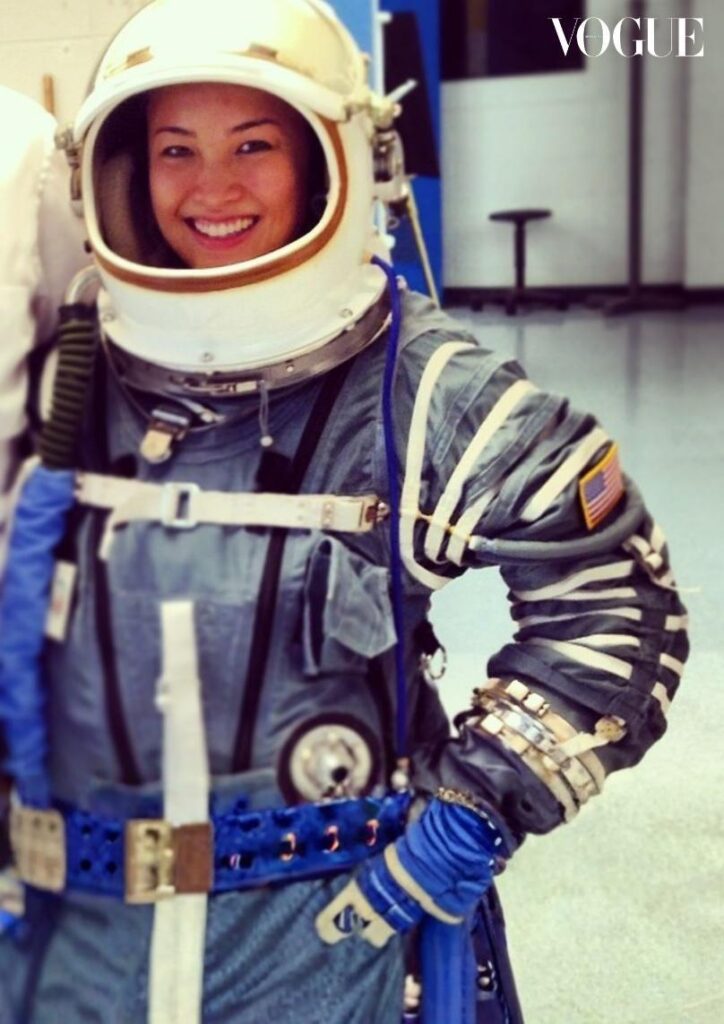
During her gap year, she also participated in a simulated mission to Mars—an exercise in endurance as much as ambition: living in tight quarters with a small crew, navigating the psychological friction of confinement, routine, and uncertainty.
It was astronaut training without the glory shot. The human side of a myth.
And when she returned to university, she did something quietly audacious: she created her own major in astrobiology—an interdisciplinary study shaped around the oldest question dressed in modern language:
Are we alone?
In her telling, that question isn’t just cosmic. It’s deeply human. It’s about connection.
Belonging. The ache beneath achievement.
The Moment the Dream Cracked Open
By the end of college, she stood at a familiar crossroads: continue checking boxes—PhD, lab years, the rigid ladder toward astronaut candidacy—or admit what her body already knew.
The idea of spending seven more years in a lab felt like a death sentence.
A professor looked her straight in the eye and asked the only question that matters in any life
that’s been lived for approval:
Do you actually want to?
She didn’t.
And in that refusal, something bigger than career planning began to surface: discernment. Not the kind that trims a résumé—but the kind that saves a Soul.
Around her, she noticed a strange undertow in the space community: people who wanted to leave Earth not out of wonder, but out of avoidance. A desire to colonize Mars because we’ve “ruined this planet,” rather than learning to repair what we’ve harmed.
She felt the paradox sharpen: what does it mean to be an explorer if your exploration is actually an escape?
Even the environmental cost landed with weight—she points out, bluntly, that sending rockets into space is not great for our environment.
And then there was the deeper fracture: identity.
When your whole world has called you future astronaut, what happens when you stop being that?
Death Before Dying
She describes it as an unraveling: identity dissolution.
A collapse of the storyline she had carried, and the storyline others had assigned her. The ground fell out, and in the free-fall she discovered something she had never been trained to navigate.
Not outer space.
Her inner world.
“There was a Universe inside me that I had never explored before,” she says—emotions, thoughts, somatic sensations.
She didn’t escape to a monastery or disappear into spiritual performance. Instead, she learned to walk with ancient practices alongside modern life, refusing the false choice between wisdom and reality.
This is where the Vogue story truly begins—not in the glamour of NASA, but in the private, unphotographed labor of becoming.
She learned that it is necessary to lean into the dark, uncertain emotions we’d rather avoid.
Because within that darkness, she insists, there is potential—infinite possibilities. And then she says the line that changes the temperature of the room:
“I don’t have to go out there in order to find myself. The Universe exists within me.”
She didn’t abandon the cosmos.
She brought it home.
The Work: Guiding People to the Edge of Evolution
What she teaches now is not a rejection of ambition—it’s a refinement of it.
Her philosophy is simple to say and hard to practice: if we stop reac
ting to our escapist tendencies and learn to stay with what makes us uncomfortable, that’s where the magic occurs. That’s where transformation occurs. That’s where evolution occurs.
She talks about nervous systems the way poets talk about love: with reverence and precision. The Discomfort Advantage, as she describes it, requires pacing—enough pressure to grow, enough support not to break.
And she speaks to a truth most high achievers recognize but rarely name: the feeling that
something is missing, even when you’ve done everything “right.”
If she had stayed on the checklist path, she believes she would have reached her life’s end
with that inexplicable emptiness still intact.
The missing piece wasn’t success.
It was her—capital M Me. So she stayed.
Not because she couldn’t have left the planet, but because she realized Earth is not a
waiting room.
It’s the classroom.
And the most urgent frontier right now is not Mars—it’s the human capacity to meet discomfort with courage, to stop fleeing our own inner weather, and to evolve without abandoning ourselves in the process.
Becoming Legendary, Not Escaping It
In an era obsessed with reinvention as aesthetics—new hair, new city, new persona—her transformation reads as something rarer:
Reinvention as responsibility.
She is, in the deepest sense, an explorer. But not the kind who disappears into the sky.
The kind who returns, points to the darkness people avoid, and says:
There. That’s the doorway.
And that is why this story belongs in Vogue:
because it isn’t about almost going to space.
It’s about choosing the greater courage—
staying on Earth, and guiding others through the raw, luminous, evolutionary beauty of becoming.
Are You Ready for Your Own Threshold?
Discover more of her work at https://danielleys.com/link-in-bio
Follow her journey and teachings at https://www.facebook.com/danielleystransformations
For PR features, editorial collaborations, and magazine covers with Danielle YS please contact Becoming Legendary by Rita Valente